Local Government Reorganisation is asking dozens of councils to do something most organisations never have to: rethink and rebuild how they deliver services to the public, at scale, on a fixed timetable, while keeping the lights on for residents who still need council tax sorted, bins collected, and school places confirmed.
Alongside this massive undertaking, GDS Local has launched. It is a real signal that central government sees local digital services as a priority, not an afterthought.
The GDS Local ambition
GDS Local is a unit that launched in November 2025 within the Government Digital Service, then part of the Department for Science, Innovation and Technology (DSIT). DSIT was dissolved in July 2026 under the new government leadership, and GDS Local’s parent unit now sits within the Department for Digital, Culture, Media and Sport (DCMS). Its remit remains the three original commitments:
- Connecting councils to national platforms like GOV.UK One Login and the GOV.UK app, so residents use one account for services regardless of which tier of government delivers them
- Co-creating a shared technology vision with MHCLG and the LGA, including common products and components, so councils stop building and buying the same thing in isolation
- Opening up shared data through the Government Digital and Data Hub, so councils can spot demand patterns early and scale what already works elsewhere in the sector
At the launch, the Minister for Digital Government, Ian Murray, put the ambition plainly: GDS Local is meant to “end the postcode lottery for digital services.”
For years, councils negotiating with a handful of large suppliers had limited leverage and limited choice, often paying full price to buy the same technology as the council next door with no shared architecture or economies of scale. GDS Local is designed to change that.
A playbook doesn’t manifest capacity
Councils have always had autonomy over who they work with and what they buy, despite the limited choice. What has been lacking to date is a foundation from which to build. An architecture that allows the council to execute on an operating model that provides transformation to service delivery.
GDS Local’s core idea, shared products and components instead of one-off procurement, is the right architecture thinking for what LGR realistically needs. A new unitary, stitching together three or four legacy versions of the same service, is the exact case modular design exists to solve: reusable components instead of another bespoke rebuild that locks in the next set of legacy constraints.
The LGA’s own research, drawn from extensive interviews, frames the challenge in almost the same terms: how councils stay safe and legal on vesting day while using the same change to set up long-term transformation. MHCLG’s Local Digital team has been building a playbook since 2025, working directly with the LGA, GDS Local and SOCITM on this exact question.
As brilliant as this is, what the guidance doesn’t solve is capacity. LGR runs on a statutory clock. Council tax, benefits, case management and dozens of other services have to work for every resident on vesting day, whichever legacy systems they were inherited from. Reconciling that across authorities that were never designed to merge already exceeds the ‘spare’ capacity most councils have, and a playbook does not add headcount or hours.
Where the two can still meet
Treating the vesting day work itself as the architecture opportunity, rather than running it and a separate modernisation effort side by side, is the only version of this that fits inside the time available.
A new unitary authority is not migrating one council’s services onto new infrastructure. It is taking three, four, sometimes five different versions of the same service, each with its own forms, rules and assumptions about how residents behave, and turning them into one service that has to work for everyone. Equally, splitting the systems, data and services of a single authority into new unitaries has it’s own set of unique challenges.
All of this happens regardless of GDS Local’s ambitions. The choice is whether it happens as a set of point-to-point fixes stitched together to pass go-live, or as the start of the modular backbone GDS Local’s common architecture and shared-products model assumes councils will eventually have.
Get the technology right and get the service wrong, and residents notice immediately. A merged case management system with three legacy processes still stitched together underneath is not a better service. It is the same confusion, running on newer software.
This is where service design, interaction design, and content design earn their place. Before a council chooses a platform, someone needs to work out what the service actually needs to do: what a resident is trying to achieve, where the current processes contradict each other, what can be simplified rather than merged, and how the service reads and feels once someone rebuilds it around GOV.UK’s Service Standard rather than around whichever legacy system happened to win.
Beneath that is the vast body of data that powers the services. For many councils this layer is siloed along old boundaries and services, fragmented and often incomplete. LGR forces councils to locate, harmonise and unify large bodies of data, requiring another major process and technology rethink. This is the same layer GDS Local’s data-sharing ambitions depend on. Getting this right will create the environment that not only gives councils the ability to transform but also to harness the true benefits of automation, AI and agentic solutions.
Why this needs a different kind of partner
Reorganisation timelines are short. Councils going through this need people who are free from legacy systems, thinking and restrictions. People who can bring clarity to fragmented data, sit with users, map a service properly, test something with real residents, and turn findings into a working design within weeks rather than quarters.
That is a different discipline from running a large, multi-year systems integration programme. Large systems integrators do that work well and are often the right partner for infrastructure at scale. Service design and data work during a live reorganisation asks for something more direct: small teams, senior practitioners doing the work rather than managing layers of delivery, and the flexibility to change course when user research or a data audit says the plan is wrong.
Mercator Digital has spent years doing exactly this work on large government projects: services used by millions of citizens, built and rebuilt against Government Service Standards, with user research and clean data driving every decision. That experience transfers directly to the opportunity behind LGR. The scale may be different, but the discipline is not.
What this means in practice
If you are leading digital, data or technology through reorganisation, safe & legal on vesting day is the number one priority, but opportunities exist in the process of reaching this that can pave the way to a smoother post-vesting acceleration.
Service design can be a guiding principle to many of the technology and process decisions that need to be made. The councils that get this right will be the ones who treat reorganisation as a chance to harness the GDS Local ambition and design something better, not just merge what already existed.
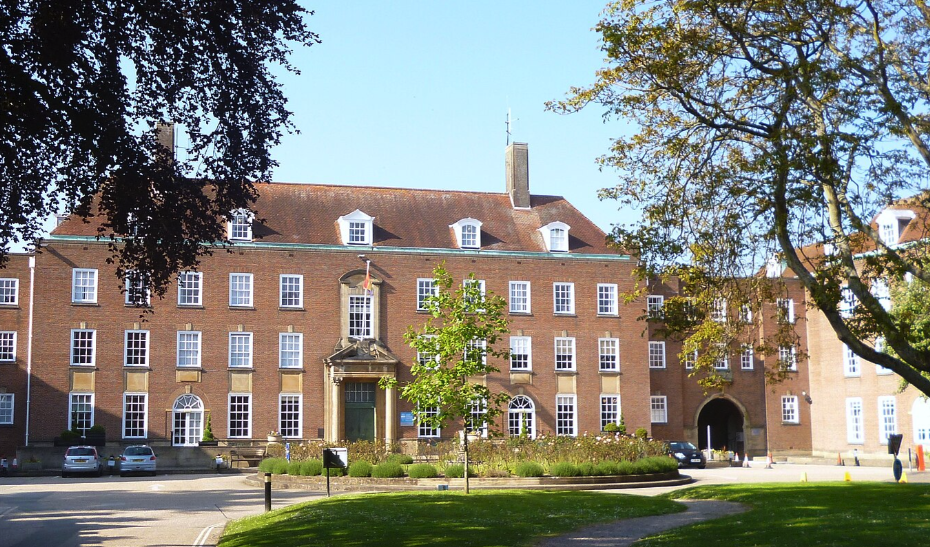
Image “County Hall, Chichester” by David960 Creative Commons Attribution Share-alike license 2.0